
Structure of the code#
1. The program RAMSES#
The root of the program RAMSES is found in amr/ramses.f90:
program ramses
 call read_params      ! Read run parameters
 call adaptive_loop    ! Start time integration
end program ramses
First, the routine read_params will load the parameters from the
namelist that was given as input by the user. Then, the routine
adaptive_loop is called. It is found in amr/adaptive_loop.f90 and structured as follows:
subroutine adaptive_loop
  ! Initialize the simulation
  call init_amr
  call init_time
  if(hydro)call init_hydro
  ...
  ! Main time loop
  do
    ! Make new refinements level 1 to levelmin
    ...
    ! Call base level
    call amr_step(levelmin,1)
    ! Do some other stuff
    ...
    ! Print some info
    ...
  end do
end subroutine adaptive_loop
The simulation starts with the initialization: arrays are allocated and set to appropriate initial values, initial conditions are calculated or read from file,… After that, the main time loop is started, which will evolve the simulation in time.
The core of RAMSES is the recursive routine amr_step found in the
file amr/amr_step.f90. In this routine, all individual physics
components are called in a specific order.
Exercise
Look into the file amr/amr_step.f90. Can you make a
list of which physical processes are modelled in ramses? Take a few
minutes to explore the different directories of the code. Can you
find out where the code of each physical process is?
2. An overview of amr_step#
A simplified schematic version of the core routine amr_step shows
the structure (see amr/amr_step.f90):
recursive subroutine amr_step(ilevel,icount)

   call refine
   call load_balance

   ... ! Some sink and particle stuff

   if(time_to_output) call dump_all

   if (conditions are met)
      call kinetic_feedback             ! feedback from stars
      OR
      call make_stellar_from_sinks
      call make_sn_stellar              ! feedback from sinks
   end if

   if(poisson) call rho_fine   ! calc density field for Poisson source term

   ... ! Some particle stuff

   ! Gravity update: compute grav potential and acceleration
   if(poisson)then
      ...
      call phi_fine_cg(ilevel,icount) OR multigrid_fine(ilevel,icount)
      call force_fine(ilevel,icount)
      ...
  end if

  if(rt .and. rt_star/sink) call update_star/sink_RT_feedback(ilevel)

  call calc_turb_forcing(ilevel)   ! turbulence forcing

  call newdt_fine(ilevel)          ! Compute new time step

  if(hydro)call set_unew(ilevel)   ! set unew = uold
  if(rt)call rt_set_unew(ilevel)

  ! --- Recursive call to amr_step ---
  ...
  !-----------------------------------

  if(conditions met) call thermal_feedback(ilevel)  ! feedback from stars

  if(sink.and.hydro) call grow_sink(ilevel,.false.)  ! sink accretion

  ! Hydro step: solve hydro and add source terms
  if((hydro).and.(.not.static_gas))then
     call godunov_fine(ilevel)
     ...
  endif

 ! Do RT/Chemistry step -> works on uold
  if(rt .and. rt_advect) then
     call rt_step(ilevel)
  else
     call cooling_fine(ilevel)
  endif

  if(pic) call move_fine(ilevel)  ! Move particles

  if(conditions met)call star_formation(ilevel)

  ...  ! Update physical and virtual boundaries

  if(MHD) call diffusion  ! Magnetic diffusion step

  if(conditions met) call flag_fine  ! Compute refinement map

  ... ! particle stuff

  if(conditions met)call create_sink  ! Sink production

end subroutine amr_step
Things are done in a specific order. The reasons for this will become more clear over the course of these lectures.
3. Recursivity of amr_step#
recursive subroutine amr_step(ilevel,icount)
  ...
  ! do things in the beginning
  ...
  !---------------------------
  ! Recursive call to amr_step
  !---------------------------
  if(ilevel<nlevelmax)then
     if(numbtot(1,ilevel+1)>0)then  !if there is stuff in next level
        if(nsubcycle(ilevel)==2)then
           call amr_step(ilevel+1,1)
           call amr_step(ilevel+1,2)
        else
           call amr_step(ilevel+1,1)
        endif
     else
        ! Otherwise, update time and finer level time-step
        dtold(ilevel+1)=dtnew(ilevel)/dble(nsubcycle(ilevel))
        dtnew(ilevel+1)=dtnew(ilevel)/dble(nsubcycle(ilevel))
        call update_time(ilevel)
     end if
  else
     call update_time(ilevel)
  end if
  ...
  ! do things at the end
  ...
end subroutine amr_step
Exercise
Write down the calls to amr_step assuming there are
3 refinement levels.
First assume there is no subcycling (nsubcycle(ilevel)==1 for all levels).
Now assume you have subcycling for all levels.
Solution
If we split the computations done in amr_step into two parts: stuff done before the recursive call to amr_step and stuff done after
recursive subroutine amr_step(ilevel,icount)

   ! calc phi(ilevel), set unew(ilevel)=uold(ilevel), ..., calc dt(ilevel)
   stuff_before(ilevel)

   ! recursive call
   if(ilevel<nlevelmax)then
      if(nsubcycle(ilevel)==2)then
         call amr_step(ilevel+1,1)
         call amr_step(ilevel+1,2)
      else
         call amr_step(ilevel+1,1)
      endif
   else
   call update_time(ilevel)
   end if

   ! solve hydro, set uold(ilevel)=unew(ilevel), ...
   stuff_after(ilevel)

end subroutine amr_step
Without subcycling
call amr_step(l-1)
      stuff_before(l-1)
   call amr_step(l)
      stuff_before(l)
      call amr_step(l+1)
            stuff_before(l+1)
            t = t+dt(l+1)
            stuff_after(l+1)
      stuff_after(l)
   stuff_after(l-1)
At the end we have advanced by dt(l+1)
With subcycling
call amr_step(l-1,1)
      stuff_before(l-1)
   call amr_step(l,1)
      stuff_before(l)
      call amr_step(l+1,1)
            stuff_before(l+1)
            t = t+dt(l+1)
            stuff_after(l+1)
      call amr_step(l+1,2)
            stuff_before(l+1)
            t = t+dt(l+1)
            stuff_after(l+1)
      stuff_after(l)
   call amr_step(l,2)
      stuff_before(l)
      call amr_step(l+1,1)
            stuff_before(l+1)
            t = t+dt(l+1)
            stuff_after(l+1)
      call amr_step(l+1,2)
            stuff_before(l+1)
            t = t+dt(l+1)
            stuff_after(l+1)
      stuff_after(l)
   stuff_after(l-1)
At the end we have advanced by 4 level l+1 timesteps dt(l+1)
4. Time stepping#
RAMSES enables adaptive time stepping where each AMR level evolves with individual timesteps. Though, the following rule always applies:
\(\Delta t^{\ell}=\Delta t^{\ell+1}_1+\Delta t^{\ell+1}_2\)
An example of time stepping with two levels in the figure below (Credits: Romain Teyssier)
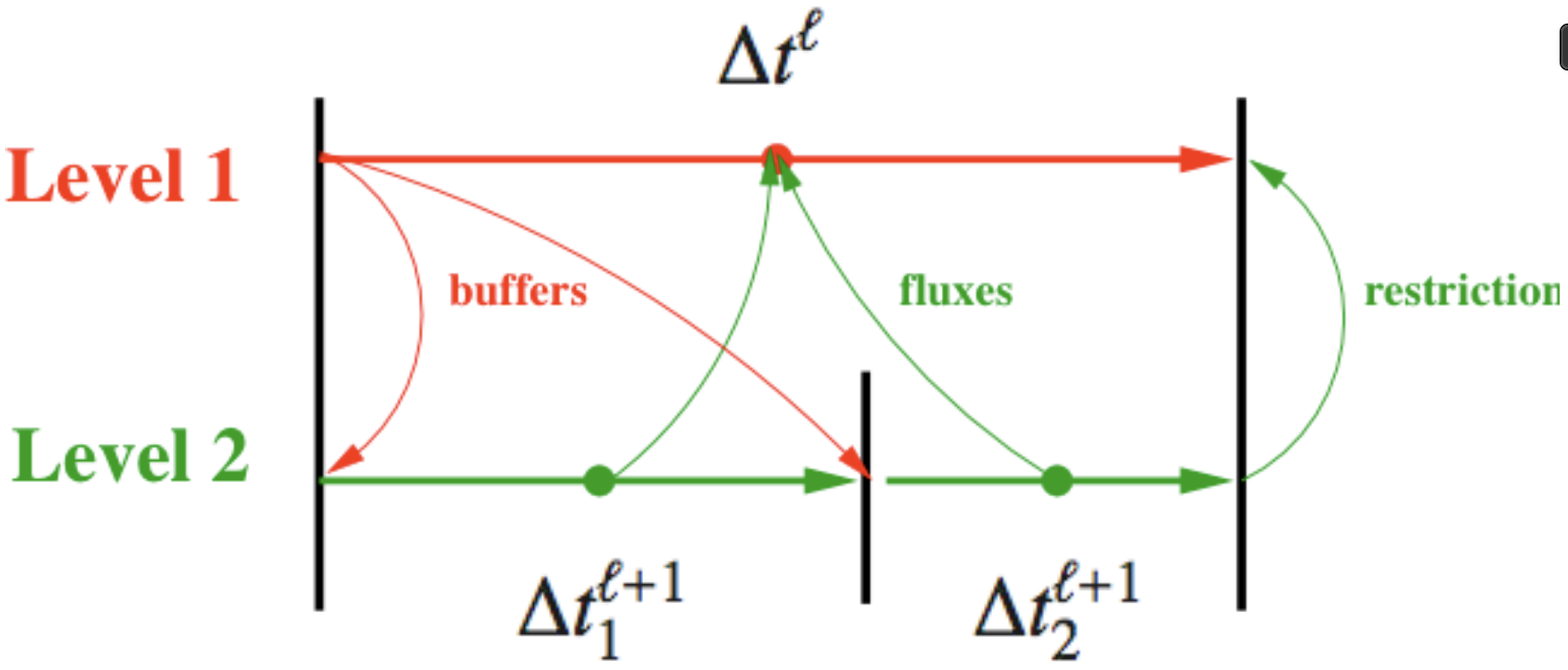
Level 2 is updated first with first with a time step of size \(\Delta t^{\ell+1}_1\) and second with \(\Delta t^{\ell+1}_2\).The coarse level \(\ell=1\) is frozen during fine level solves (one order of accuracy down !). The fine flux are averaged in time at coarse fine boundaries. Then level \(\ell\) is updated.
\(\bf{F}^{n+1/2,\ell}_{i+1/2,j}=\frac{1}{\Delta t_1^{\ell+1}+\Delta t_2^{\ell+1}}\left( \Delta t_1^{\ell+1}\frac{\bf{F}^{n+1/4,\ell+1}_{i+1/2,j-1/4}+\bf{F}^{n+1/4,\ell+1}_{i+1/2,j+1/4}}{2} + \Delta t_2^{\ell+1}\frac{\bf{F}^{n+3/4,\ell+1}_{i+1/2,j-1/4}+\bf{F}^{n+3/4,\ell+1}_{i+1/2,j+1/4}}{2} \right)\)
The timestep is computed in pm/newdt_fine.f90. For more information,
see Section 2.4 in the RAMSES paper (Teyssier 2002).